London is so vast now that it is difficult to imagine how it might have been, long ago. Before the Romans sought to increase their power and control trade in this part of the world there were only sporadic small groups of dwellers, Celts, dotted throughout the island, some 3 or 4 million of them, mainly involved in agriculture and self sufficiency, essentially living in smoke-blackened, thatched-covered village forts, led by their local chieftain. Cattle and sheep gave them milk, cheese, leather, wool and meat. Life was good. There was no London as such and squabbles were infrequent spats with neighbours about where one's sheep should roam, or who owned which horse.
Then came the Romans. Looking for tin, mainly.Though they hungered for all the metals on this island they called Britannia: the land of tin. Julius Caesar softened up the inhabitants with his well trained troops on a couple of occasions, but Claudius dealt the heavy blows, so after 43 AD the island came to be in the hands of the Romans, the prevailing power at the time. Claudius even named his son Britannicus, so sweet was the victory. They built roads and bridges and criss-crossed the land with mines and settlements and protected army bases from which they went about their daily business.
The Thames river settlement soon became one of the busiest spots in the country, with loaded ships entering and leaving. Its reputation as a trading port grew. Others around the ridges become covetous, and started taking pot shots at the Romans, irritating them: Angles and Saxons included. So, the Romans decided to build a wall around their southern trading port. This happened around 200 AD. It was over 6 metres high, quite Trumpian. Protecting what they needed for their troops and trade. It had many gates built as entrances and exits, along with towers and crenelated battlements as spy eyries and shooting galleries, strengthening their fort. Parts of the Roman wall that have not been completely robbed for recycled material can still be found today, looking much as they ever did. Surrounding just a few hundred acres.
The land, protected on three sides by the wall with the Thames on the fourth side, became known as Londinium. This, today, is the financial heart of London: 'the City' that, again, we are walking. The Romans dug in and made themselves completely at home here, building as they did in Italy, even finishing their homes with their beautifully laid tessellated floor tiles. Many of which are still being discovered today. This remnant of what once was a Roman home was found in situ, in what is now the crypt of All Hallows by the Tower, a wonderful church by the river, which has much to tell about London's growing pains.
Trouble set in back home, though, and the Romans needed all their men and their horses and equipment to fight back barbarians trying to attack their homeland. The power vacuum left created room for the Angles and Saxons from southern Denmark and northern Germany to move in and inhabit the space, just like powerful chess pieces. They, too, have left their mark on London. Here is an elegant Saxon tomb decoration, a wheel head cross, dated about 900 AD, only discovered while rebuilding parts of All Hallows by the Tower after the blitz damage of the war.
They even recycled Roman tiles in order to build this lovely Saxon arch that also survives in that space. But, protecting their pilferings long term became impossible. The Normans had Britain in their sights and in 1066 made good on their many threats and finally invaded, taking over the land quite forcefully. William the Conqueror built towering castles on vast strong holdings and granted great tracts of land to his most noble and powerful supporters, starting a whole new complicated web of political interconnectedness and allegiance building that has defined politics and posturing ever since. There was a new ruling elite throughout the land. And London had a brand new Tower, signposting ownership: the Normans were here. And they intended to stay.
Folk from other places still came during the following decades and centuries, using diplomatic means and their powerful allegiances. A group of monks from Italy presented papers from the Pope, asking if they might settle in London. They were well received and built an abbey near Tower Hill around 1244. The Crutched Friars they were called, as they carried a crook topped with a crucifix, a crux, a cross. They left their name on the city.
As did the Jews, in Jewry street, after William the Conqueror invited them in. He needed to borrow money at low interest rates, as the taxes he was collecting were not covering his expenses, and it was a time when Christian churches forbade lending money for interest, which stymied financial movement somewhat. The Jews were not so constrained. They could and would deal. In exchange, William offered them freedom of movement throughout the land, and for a time that worked. But, the world always turns, and those Jewish gains were eventually obliterated by Edward 1, responding to pressure from locals who mistrusted Jews, so there followed a long spell of pogroms and massacres until the ghettos of London were emptied, their inhabitants expelled. Only the name of a street, and a remnant synagogue survives from these times, albeit one with an astonishing record for holding 300 years of continuous service.
The vacuum left by the Jewish merchants was filled by money men who came from Lombardy. Many, who started out merely as merchants with big basements able to be used for safe storage for which space they charged a fee, came to be the leading figures in Lombard street, the main banking street of London city. They negotiated money deals on tables, or banco, as these are called in Italian.
Money business was initially all done at the Exchange. But the talk about it was done by men in the coffee shops where the ship's captains gathered, the ship owners, and many other lesser merchants with an eye on a prize.
One of the coffee shop owners was Edward Lloyd. He built himself a shop not far from the Royal Exchange, close to merchant sellers. He looked, he listened, he learned, while serving coffee, tea and fruit drinks. He thought to publish a regular newsletter on the movement of ships and their products, keeping tabs on different ports all around the trading world by networking with other correspondents. His trade increased. He began holding candle auctions selling the cargo of incoming ships out of his coffee shop. The winner, the last bidder as the candle guttered, might take home 'a parcel of Turkish coffee' or 'a hogshead of the finest French wine'. And so began Lloyd's. Its quarters today just steps from where Edward had his coffee shop. One only of the many monoliths of a world banking and insurance empire that had become concentrated in this contained area, once called Londinium.
Trade signs were hung to identify their addresses. Today, these are golden. One, the Golden Grasshopper, is the symbol of the Gresham family of Norfolk, whose son, Thomas, built the first Royal Exchange. It is not the symbol of a flighty son who could not decide or alight on what he wanted to do with his life. Though that was true for a time. Rather, legend has it that Thomas' ancestor, Roger, was abandoned as an infant in Norfolk fens, and only the constant chirrup of a grasshopper led him to be found, so the grasshopper very likely came to be seen as a symbol of luck, hope and success.
But just as it was all getting off the ground the Great Fire ripped through so much of it and left char and rubble, burning over 13,000 homes to the ground leaving 70,000 Londoners homeless. It raged for days. Many folk, though, had some warning. Samuel Pepys, for one, who worked in the Naval Office near the Thames and lived just a block away in Seething Lane, had enough time to have all his worldly goods loaded on to a wheel barrow and rolled to safety. His more important treasures, his parmesan and his wine, he buried in a deep pit and covered for protection. He then climbed the tall spire of All Hallows by the Tower and watched the fire burn, then wrote about it in his diary for history buffs to read.
Wells were never more important. Well water protected a good section of this part of the city, though later proved too contaminated for drinking so the wells were covered and the taps detached from the water source. Underground brooks and streams, too, played a part. In the city, under this home, runs an underground stream that can be accessed, still, via steps in the cellar. This is the city home, the Mansion House, of the Lord Mayor of London during his term of office. He is the administrative and ceremonial leader of the City of London. As opposed to the Mayor of London who administers all of London, apart from this section of old London. Two separate entities. Even the Queen has to be invited into this part of the city.
It has survived through the ages and grown bigger and stronger as time goes on. With Brexit now on the horizon it would be so interesting to return to this golden square mile in about a decade or so to see what changes that vote has wrought. One thing certain, though: change is the only real constant here.
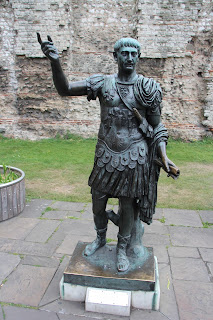 |
| Romans came to the land of tin |
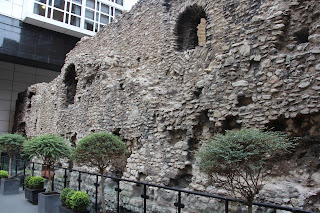 |
| Part of a Roman wall that still stands |
 |
| Model of the walled Londinium |
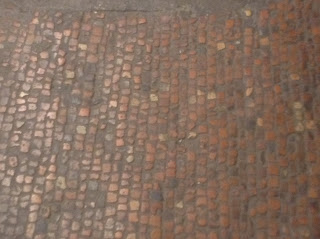 |
| Roman floor tiled |
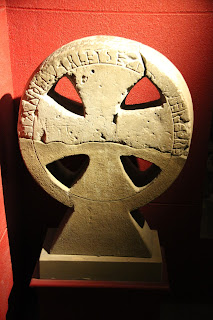 |
| A Saxon wheel head cross tomb decoration |
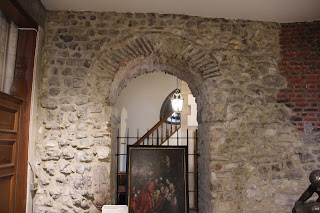 |
| Roman tiles pilfered by the Saxons for their arch |
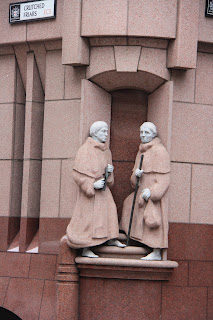 |
| Crutched Friars |
 |
| A very simple synagogue |
 |
| Coffee shops became business houses |
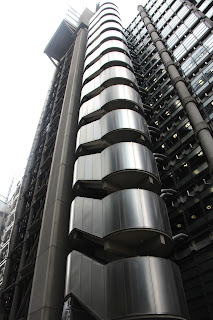 |
| Lloyds |
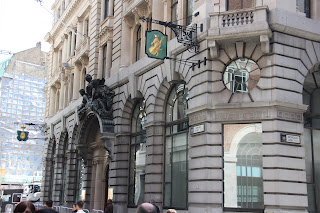 |
| Gilded trade sign |
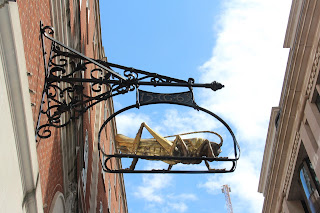 |
| The golden grasshopper |
 |
| This was this part of London just before the Great Fire |
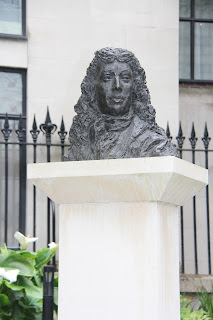 |
| Samuel Pepys |
 |
| Pump for well water beneath |
 |
| Mansion House, the Lord Mayor's home in the city |
 |
| The entrance to the Hoop and Grapes, around so long it is leaning heavily on its neighbour |